
beast lightnin', go beast lightnin'
Or, the cryptid-packed tale of the Beast of Gévaudan (feat. many delightful illustrations).

Hello friends!
This week’s dirtbag isn’t an individual so much as a wacky situation, an approach for which this publication has at least two precedents. I always feel like if a Situation gets a catchy name it basically counts as a person, and besides I wrote an entire paper in grad school on the concept of early modern werewolves and I’ll be damned if I don’t bring it up once a year one way or another.
“Hey Allison,” you ask, “where the fuck did the werewolves come from? This is a history newsletter.”
Well, buckle up, friends, because it’s time to talk about:
The Beast of Gévaudan, the 18th-Century French Cryptid Murder Mystery of Your Dreams, Assuming You and I Share the Same Extremely Specific Type of Dreams
Sidebar: I have no idea how widely known this story actually is. It could be incredibly famous, or it could be I just live my life so that I’m constantly surrounded by people who love the Beast of Gévaudan. So I’m just gonna tell it, and if you’re a BofG girlie like me you can sit back and enjoy a friendly visit from our boy.
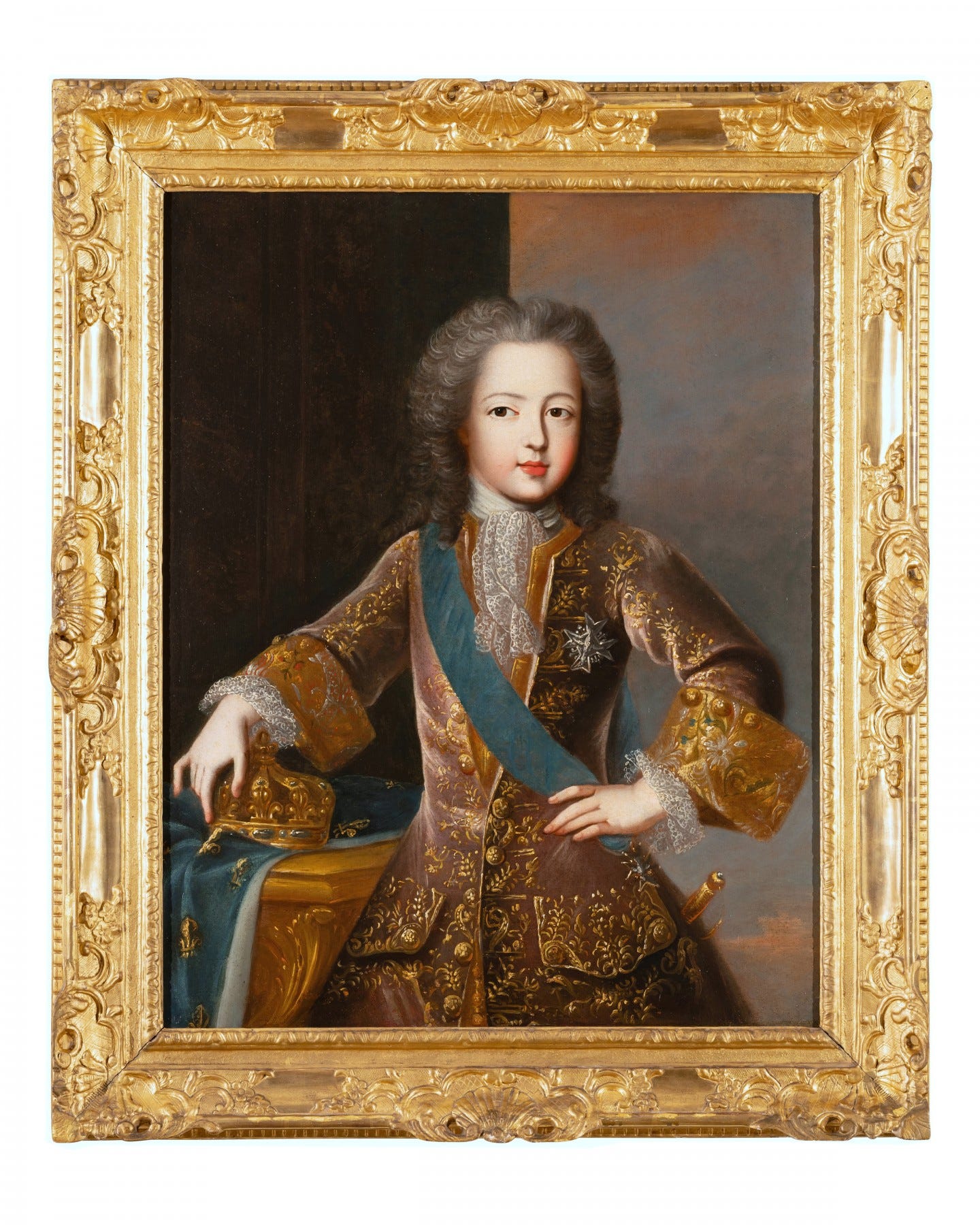
Our story opens in 1764, in the rural French province of Gévaudan. The King of France is Louis XV, AKA the one in between the Two Louises You Know (Versailles Louis XIV and Guillotine Recipient Louis XVI). Doesn’t really matter who’s king at first, though, because this is the smallest of small-town stories and the king is off at Versailles having sex with his many mistresses or whatever.
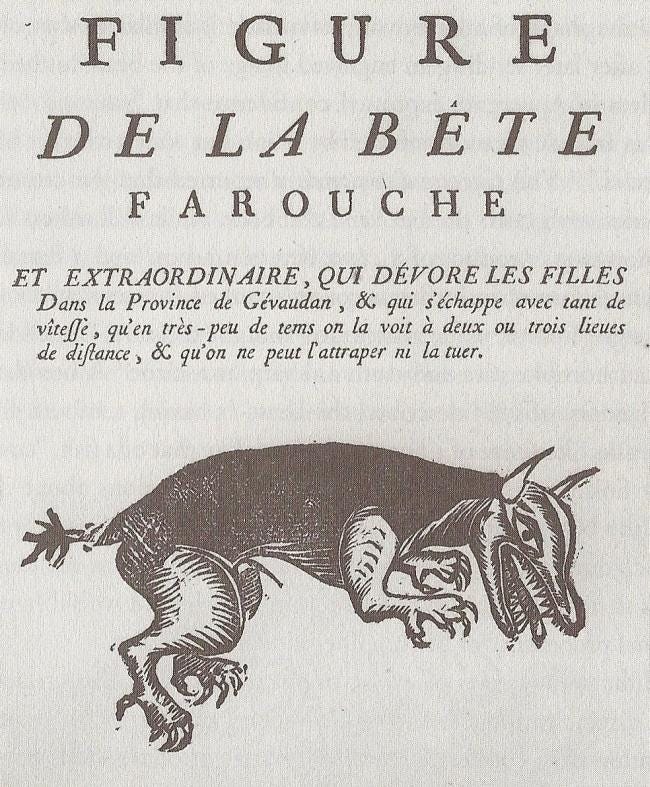
Meanwhile, in the countryside, a 14-year-old girl is torn to pieces by a large wild animal which witnesses described as “like a wolf, yet not a wolf.”
This is exactly the kind of stupid non-description that makes cryptid fans like me go absolutely nuts. Like a man, yet not a man? Like a moth, yet not a moth? Say less, this creature is my baby and I will buy any merch you put it on. It gets even better when you learn that on the girl’s death certificate, the town coroner wrote that she was killed by “The Ferocious Beast,” which I physically cannot read in any voice other than Maurice from Disney’s Beauty and the Beast.
And our initial victim wasn’t the only one. One after another, the people of Gévaudan fell prey to the monstrous beast throughout 1764 and 1765. Every death happened the same way: in or near the woods of Mericore, with the victim’s face or throat torn out by a wild animal. By the end of this saga, we are going to be up to, allegedly, 110 deaths.
This is a real problem for Gévaudan. One or two Beast Murders is bad, but 110 Beast Murders starts to look like the local government is sleeping on the job. So the townspeople form the classic French Angry Mob with Pitchforks and Torches and set out to Kill the Beast.
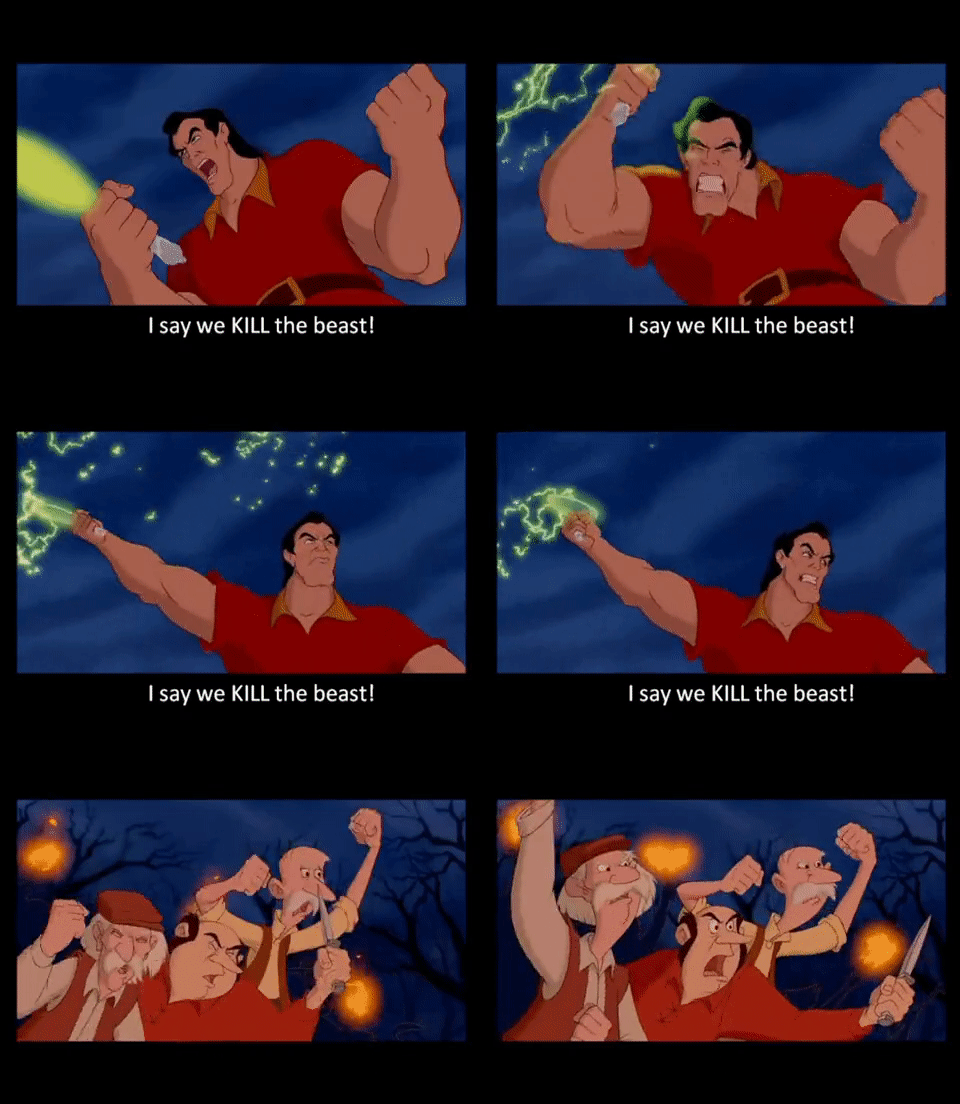
Except they CANNOT KILL THE BEAST.
They try for a YEAR AND A HALF. No dice.
The Beast runs like a wolf but can stand on two legs. It’s impossibly fast and incredibly strong. It’s roughly the size of a barge cow. Bullets bounce off its impenetrable hide. Could it come back from the dead? Maybe!
Rumors start to fly that it’s not a wolf at all but a werewolf, or a demonic creature sent by God to punish Gévaudan for its sins. The local bishop delivered a sermon instructing the town to repent, and everyone went into 40 days of fasting and prayer to see if that stopped the wolf attacks.
It didn’t, and eventually our absentee king had to get involved.
But first…
Join Me, Won’t You, in Historical Werewolf Corner?
1764 might seem a bit late in the historical record for the entire town believing they’re being scourged by a werewolf. In fact, I have to remind myself every time I think about this story that it’s not set in 1264. But Europe has a long and delightful history of genuinely believing in werewolves, both as a supernatural punishment and as an actual real disease you could catch.
The supernatural punishment side is more or less what you’d expect: evil man makes a deal with the devil, gets violent werewolf powers, can only be slain by appropriately holy adversary, &c. The best-known story in this style is the tale of Peter Stubbe, who in 1530s Germany admitted to making a deal with Satan where he got a magical belt that let him turn into a wolf. In this form, he ate 14 children, 2 pregnant women, and a lot of goats before being caught, tortured, and killed on the wheel.
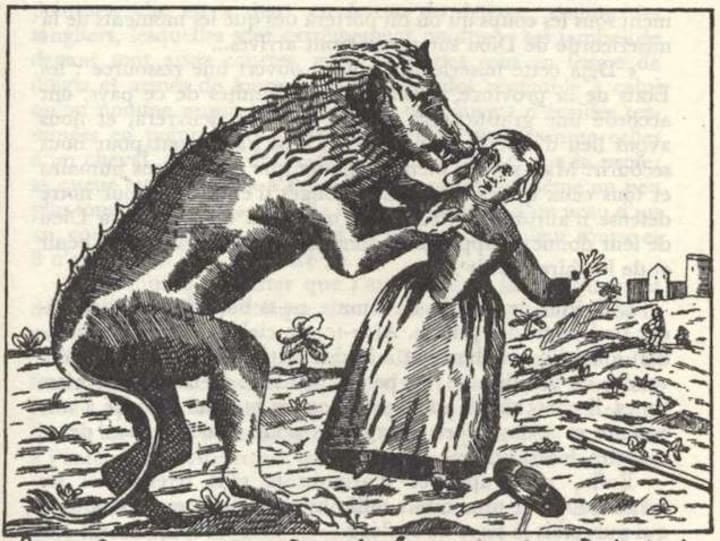
(Sure, all the werewolf stuff only came up after the torture started. And sure, Peter Stubbe was the richest guy in town and the magistrate then got to divide up all his property. But the fear of werewolves was earnest, and that’s what matters for Historical Werewolf Corner.)
It’s the medical part that truly delights me, because at the time, lycanthropy was an actual physiological disease you could catch by knocking your humors out of balance. We’ve talked about Galen and his wacky Teenage Mutant Ninja Turtles-style medical practice before, and though Galen himself was never like “hey this is how you become a wolf,” later doctors extrapolated the practice and believed that an excess of black bile could have, as one of its key symptoms, wolf delusions.
This belief gave rise to my single favorite scene in all of early modern drama: that part in John Webster’s The Duchess of Malfi where Ferdinand is wandering around a graveyard at night gnawing on a severed leg and howling like a wolf.
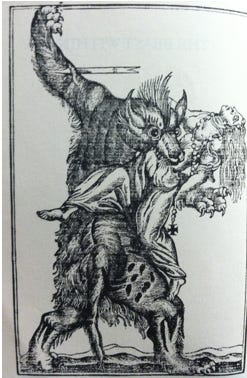
So there’s your lesson in Renaissance Werewolfery for the week. And now, what I know you’re all really here for…
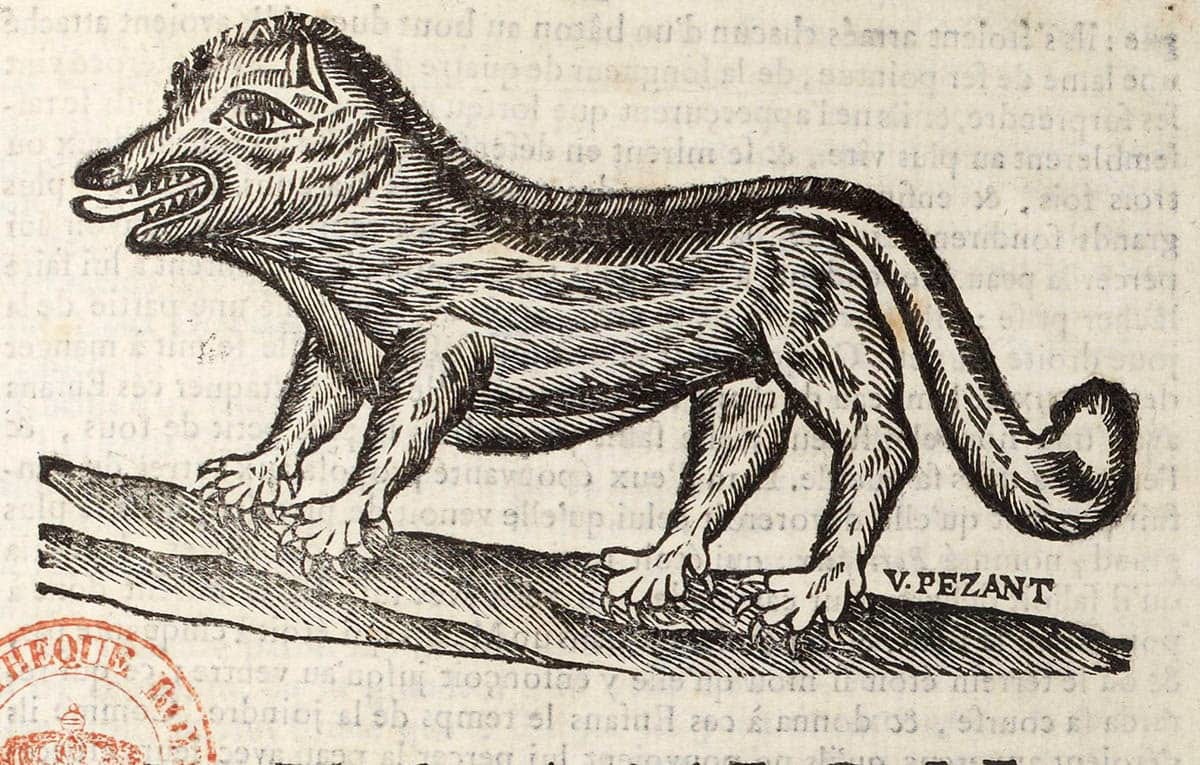
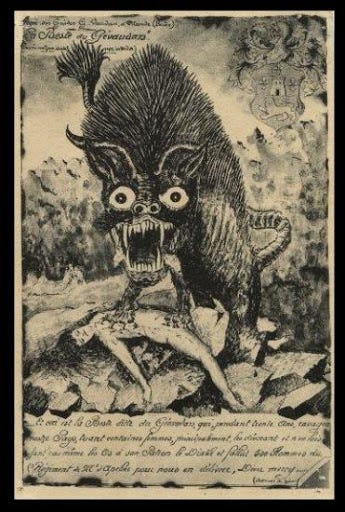
A Collection of Artistic Representations of the Beast of Gévaudan, in Order of Most Terrifying to Least Terrifying
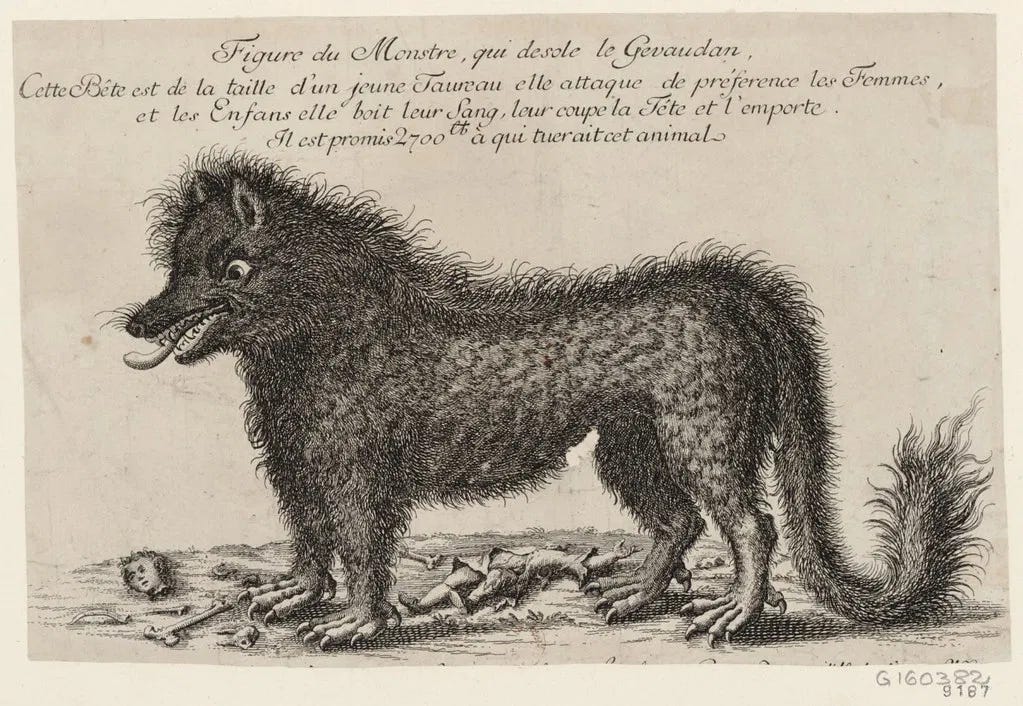
Number One: Whatever the FUCK THIS IS.
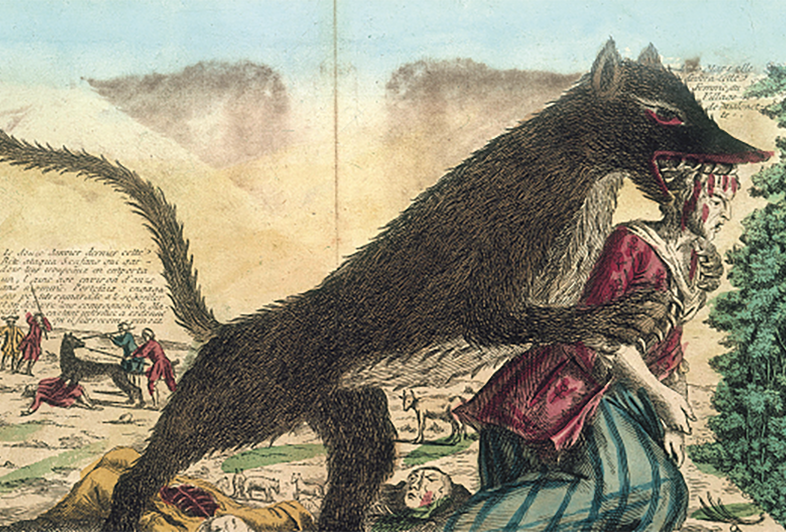
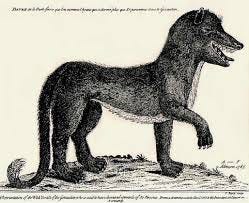
Number Two: The rendition I like to call Giant Murder Squirrel. There are many versions that all sort of look like this, but I’ve selected the below for the obvious mid-lady-head-bite flair and also the apparently opposable thumbs, which is alarming and means this thing could open doors.
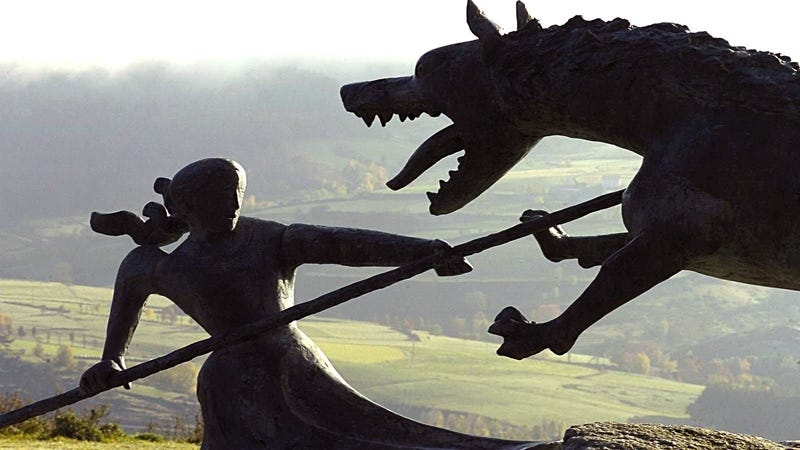
Number Three: The monument to the Beast of Gévaudan that can be seen today in the French village of Auvers. Scary? Somewhat. IMPOSSIBLY BADASS? Without a doubt.
Number Four: In which we take the sharp turn away from Ferocious Beast and into Slightly Derpy Otter/Wild Boar hybrid we saw a peek of previously.
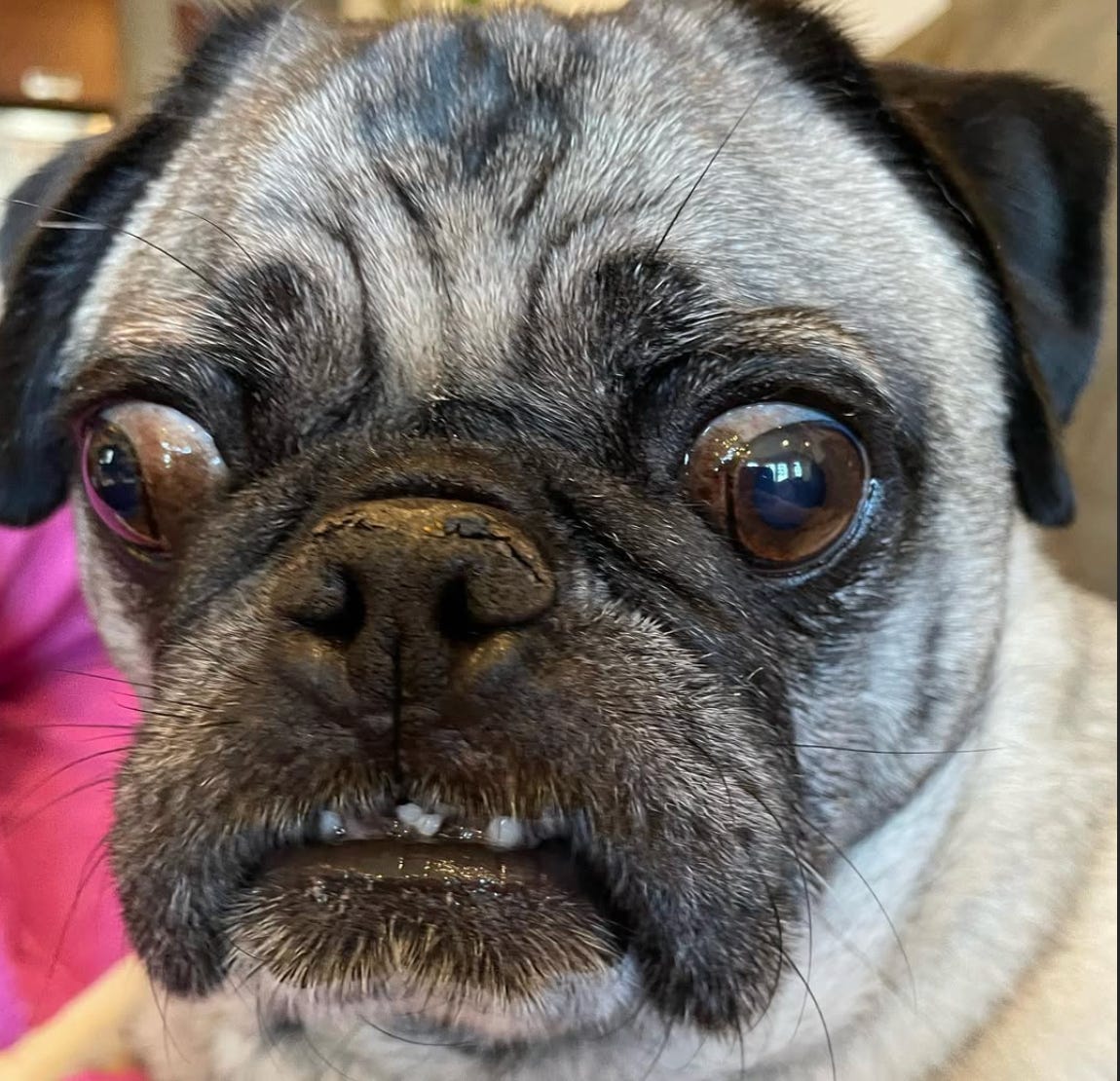
Number Five: No, I’m sorry, this is a picture of my sister’s pug and you cannot convince me otherwise.
You think I’m joking, but look. Corporate wants you to find the difference between these two pictures.1
OK. Back on track.
Spear Perfection
By the time the death toll is in the multiple dozens, Louis XV has stopped having sex with his mistresses for long enough to realize that something is not going well out in the countryside. First he sent in the army, but the army couldn’t catch the wolf and nobody wanted them in town.
So it was time for Plan B: A pair of professional wolf-hunters named Jean Charles Marc Antoine and Jean-François Vaumesle d'Enneval.2 The two hunters, sharing six first names between them, turned up in February 1765 with a whole pack of hunting dogs. They spent the next four months hunting wolves, and they killed a bunch (professional wolf-hunters and all). Unfortunately, the attacks continued, so clearly these weren’t the right wolves.
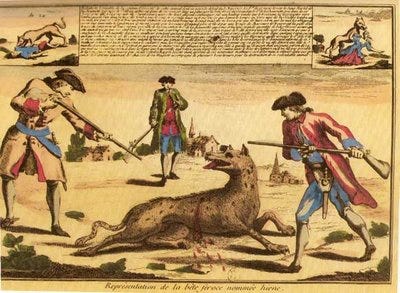
The king then turned to Plan C: François Antoine, the Royal Lieutenant of the Hunt. He organized a huge hunt and got all the townspeople in on it, setting us up for Beauty and the Beast Mob II. But the hunting party was almost immediately ambushed by the Beast. And because not a single man in this story is worth anything, Antoine had nothing to contribute to the situation as the Beast rushed at a 20-year-old woman named Marie-Jeanne Vallet.
However, the Beast hadn’t counted on one thing: Marie-Jeanne being a badass. She grabbed a spear and stabbed the Beast in the chest, and it slunk off into the woods, badly wounded. I assume Antoine somehow took credit for this, because of the overall vibes he gives off in this story.
Also, I tried to find a portrait of Marie-Jeanne to include in this story and the only ones available are the statue from Auvers that I already included above, and a character from the TV show Teen Wolf. So we’ll all have to use our imaginations.
In Which the Real Winners are the French Taxidermy Industry
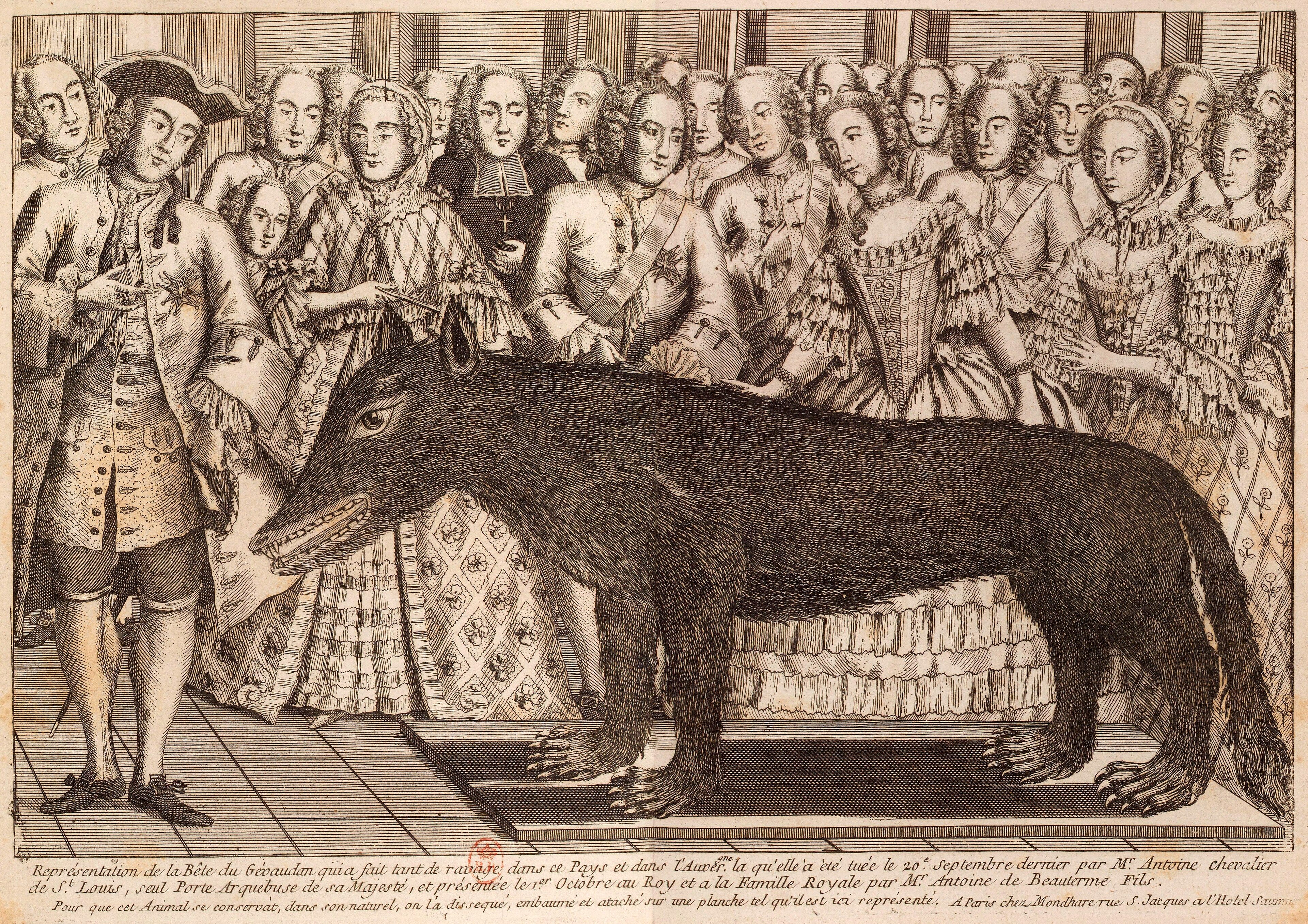
A few months later, Antoine shot a fucking enormous wolf, which he had taxidermied and brought to court to prove to King Louis XV that he had finally slain the Ferocious Beast of Gévaudan. The animal had a big scar on its chest from being stabbed by a spear, so folks were reasonably confident this was the right one. Antoine got a fuck-ton of money and became a minor celebrity, insofar as “I shot a wolf once” can bring you fame and fortune.
At least! Until people started being eaten by a Beast again!!
Between December 1765 and 1767, another couple dozen people in the region were torn apart by a not-wolf, and no one could figure out what was going on or how the hell to stop it. The townspeople asked the king if he could send in reinforcements like last time, but Louis XV looked at the giant taxidermied wolf still sitting in his throne room and said “nah, y’all are good, I don’t need two.”
At long last, in early 1767, a local hunter named Jean Chastel killed an equally big-ass wolf with a giant silver bullet, and the killings trickled down and stopped. Chastel also taxidermied this Second Beast and brought it to Versailles to show the king, hoping for an equally good payout the second time around. Unfortunately, Louis XV refused to see 2 Beast 2 Furious because the taxidermy wasn’t very good and it smelled like rotting flesh, which, ok valid.
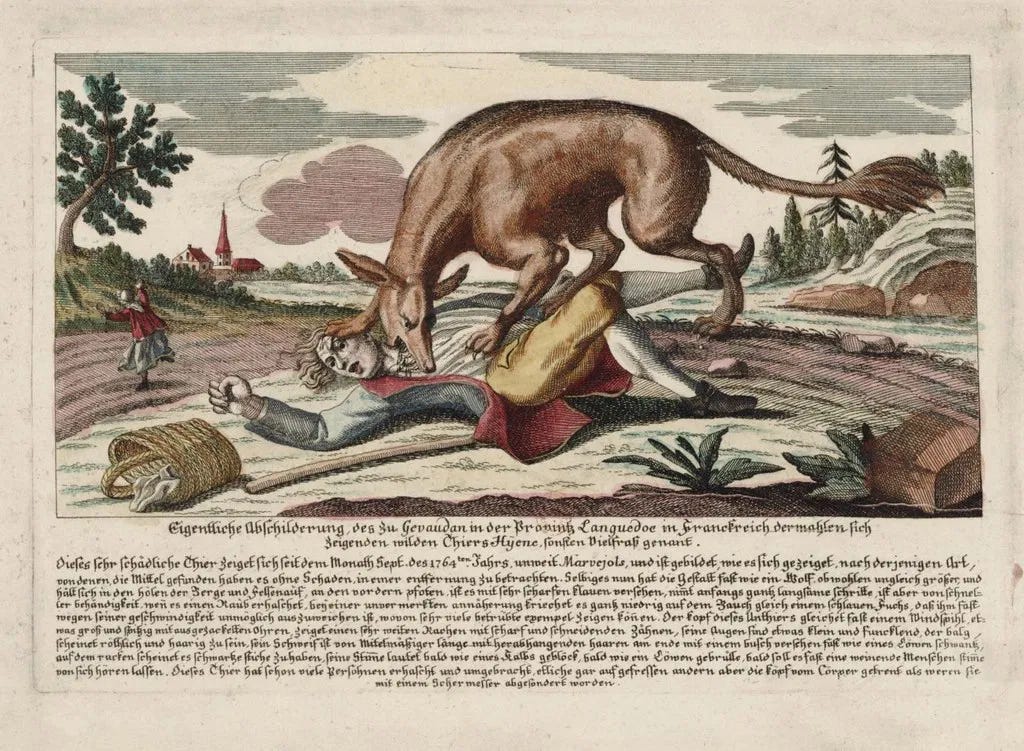
By the end of 1767, the attacks had stopped, and life pretty much went back to normal. To this day, no one’s exactly sure what kind of animal the Beast of Gévaudan was. Most people think it was just a very large wolf or pack of wolves, although some have suggested it was a hyena or a bear or an escaped zoo lion. I prefer to stick to my guns and insist it was an 18th-century werewolf. It makes as much sense as anything else.
All right, friends, that’s all for this week! Until next time, be well, and if you know of somewhere I can buy Beast of Gévaudan merch please let me know, because I desperately want a tote bag with the crazy-eyes wolf (Number One above) that says “BEAST MODE” in an old-timey Gothic font and if I have to make it myself I will,
-Allison
I’m obligated to tell you that this dog has an Instagram and that yes, he always looks like that.
For what it’s worth, this part of the story is where the 2001 French film Brotherhood of the Wolf picks up, and I simply have to recommend you watch it. It is the most French thing I’ve ever seen with my human eyeballs. I screamed several times, not in fear but in “are you ALLOWED to do that in a MOVIE?” You might think you can predict the twist but let me assure you, you CANNOT.
Can we call this cryptid the Chapeaucabra?
The illustration with the taxidermied beastwolf kind of looks like that scene from Being John Malkovich where everyone has Malkovich's face.
I hope you review Robert Eggers' upcoming Werwulf movie.
Perhaps a serial killer was hiding behind werewolf mythology to commit his crimes?