
jacobin there, done that
Or, the tale of France's shoutiest revolutionary, Jean-Paul Marat.

Hello friends!
I could have timed this newsletter to coincide with Bastille Day, but this is when I got it done, and I have never given off the energy of a person with much of a plan. So you get this when you’re getting it, and I hope you enjoy!
I had the great pleasure not too long ago of joining the wonderful Ann Foster to record an episode of the Vulgar History podcast, in which she asked me to, quote, “explain the men of the French Revolution to me in a way that won’t make me fall asleep.” That should drop in podcast feeds soon, if you want to hear Ann and me talk about old-timey sewage for about 80 minutes.
But researching for that episode brought me back to one of the all-time historical dirtbags I’ve mentioned a few times in other newsletters but never given the full spotlight. So I hope you enjoy this deeper dive into:
Jean-Paul Marat, the Oscar the Grouch of the French Revolution
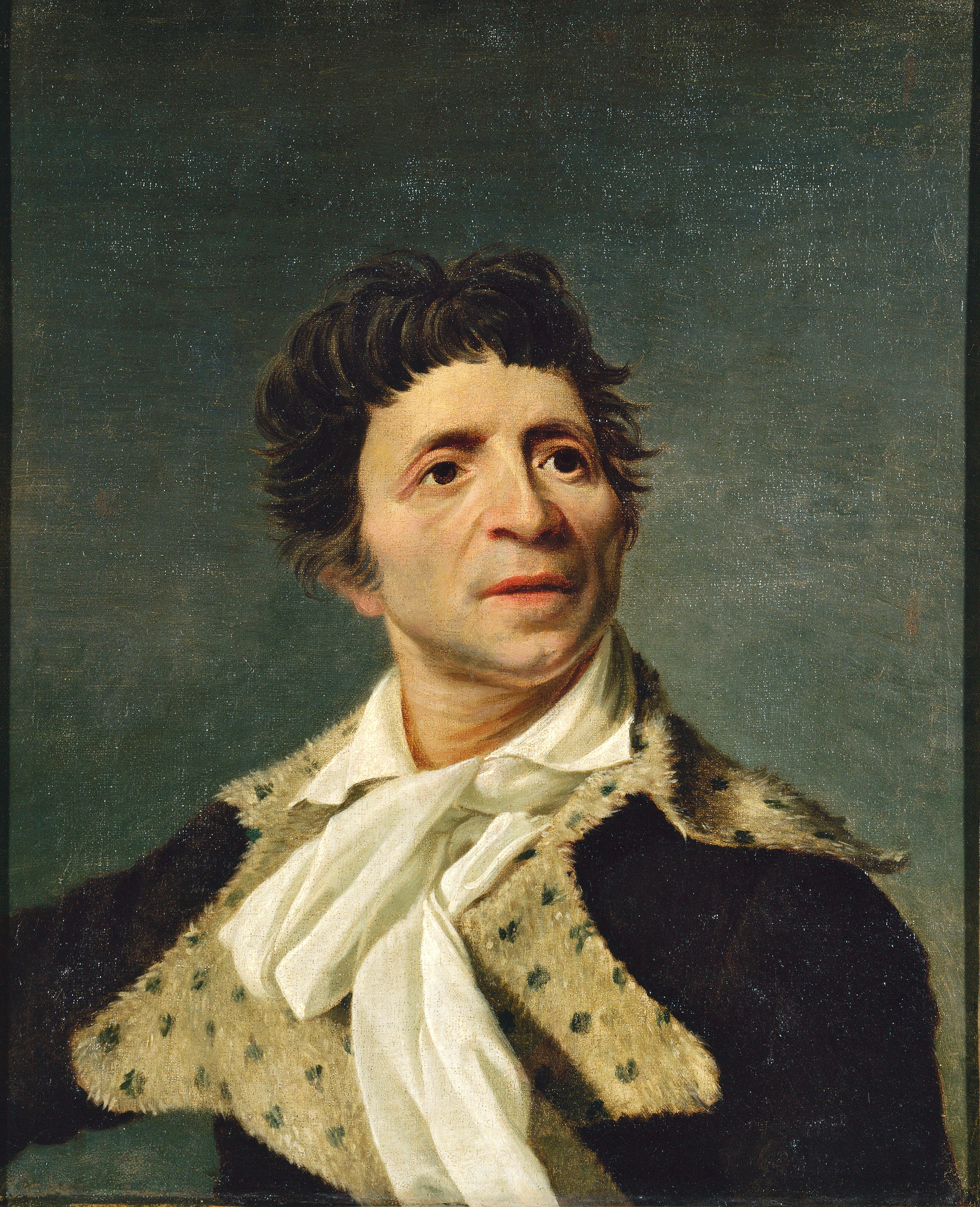
Marat was born in 1743 in what was then Prussia but is now Switzerland, the oldest of five children. He was a good student and left home at 16, first to work as a tutor for a rich family in Bordeaux and then to Paris to study medicine. I say “study” in quotation marks because this was the 1770s, a time when—as noted elsewhere in this publication—medical training involved three leeches and a dream.
Throughout the 1770s, Marat was traveling around Europe casually practicing medicine but mostly writing spicy pamphlets and treatises on the subject of liberty and the consent of the governed. I was musing the other day that we don’t have enough spicy pamphlets these days, before realizing that Substack is really just the 2025 version of French Revolution Pamphlet Culture.
Marat’s first big hit was a book called Les Chaînes de l’Esclavage, which yelled about the sins of monarchy and came out in 1774 to huge critical acclaim by British revolutionaries. Marat claimed to have written the book over a period of three months, consuming nothing but black coffee and sleeping two hours a night. Having been on a deadline for a whole-ass book, I find this one of the most realistic claims Marat makes about himself.
Brief sidebar: Marat will say a lot of things throughout this story. I believe maybe 7% of them. To save us all time, I’m going to add three asterisks (***) after every thing Marat says that I personally believe is bullshit.
After becoming famous in England, Marat settled in Paris in 1776 and began the traditional 18th century career path of “a little of this, a little of that.” He wrote articles for the newspaper. He lackadaisically practiced medicine. He published an article on the subject of “my friend has gonorrhea and here’s what he should do about it” (true). He experimented with electricity and made friends with Benjamin Franklin. He became the personal physician to the bodyguard of the king’s brother. He feuded loudly and often with the French Scientific Academy.
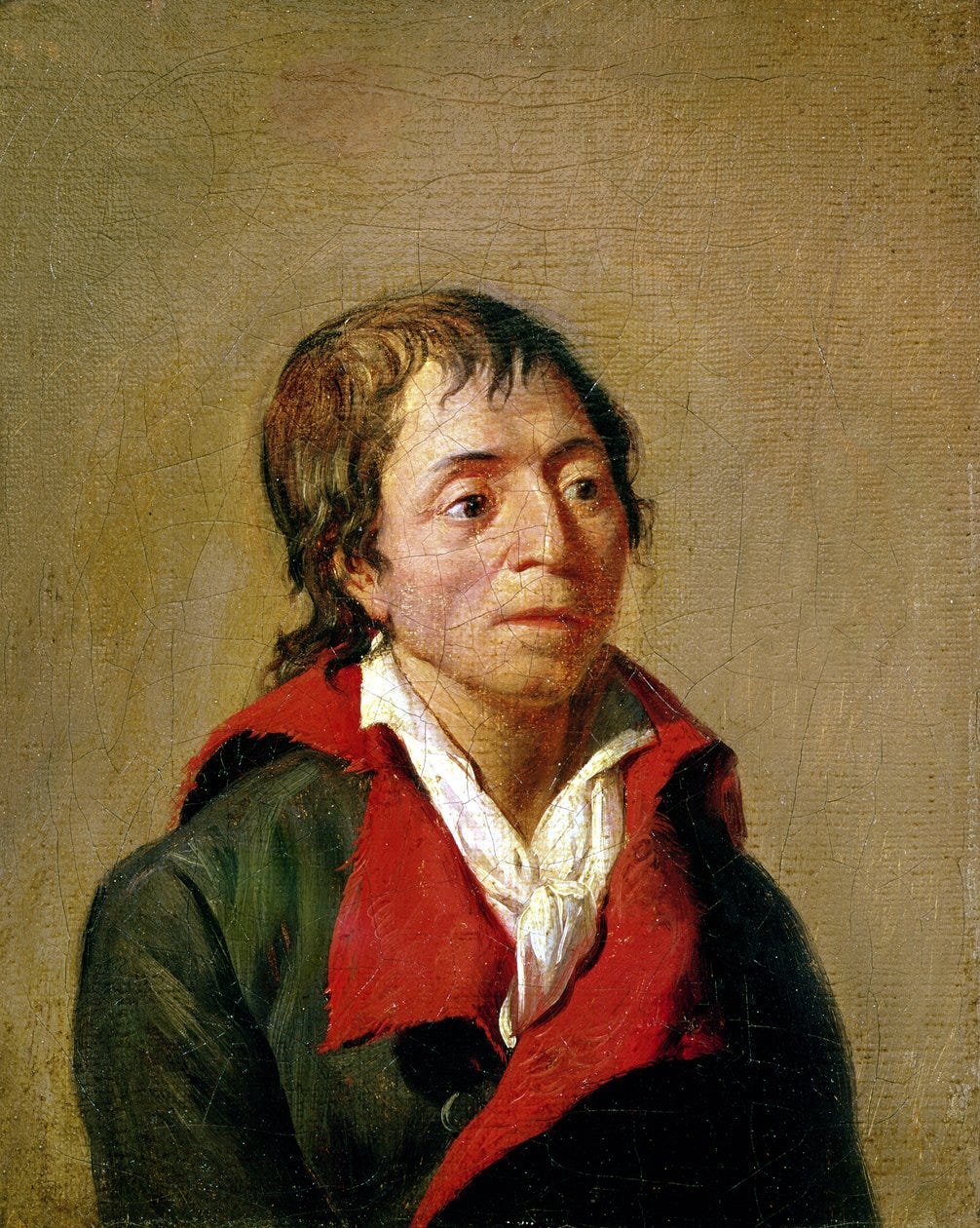
The world simply does not allow for extreme dilettantism the way it used to, and that makes me sad. I wanna build a career on “I had a thought today and now I’m gonna make it everyone’s problem.”1
In Which Marat Continues to Have Thoughts and Make It Everyone’s Problem
This brings us to 1778, when King Louis XVI assembled the Estates-General. Oversimplifying to a ludicrous degree, the Estates-General were the every-so-often all-staff meeting France had been holding since the Middle Ages. Representatives would be appointed to this meeting from the three main categories of people: the nobility, the clergy, and the everybody else. Each group would get one vote, and in this instance they were all coming together to decide “how can we fix France so people stop starving to death.”
Marat, being a rabble-rouser who would launch a revolution at the drop of a hat, was thrilled to death to hear of this. He was lying ill in bed at the time, but when he heard the news, he leapt out of bed fully healed and immediately started writing fiery pamphlets arguing for power to the people.***
Marat knocked out pamphlet after pamphlet, which he said were instant best-sellers and instrumental in inspiring the people of Paris.*** He even wrote his own constitution for France, a thing no one had asked him to do, especially as he did not even participate in the Estates-General himself. Marat jumped right over all the medium-intense reforms and started yelling for a full republic and the overthrow of the king right out the gate. The overall effect was something like this:
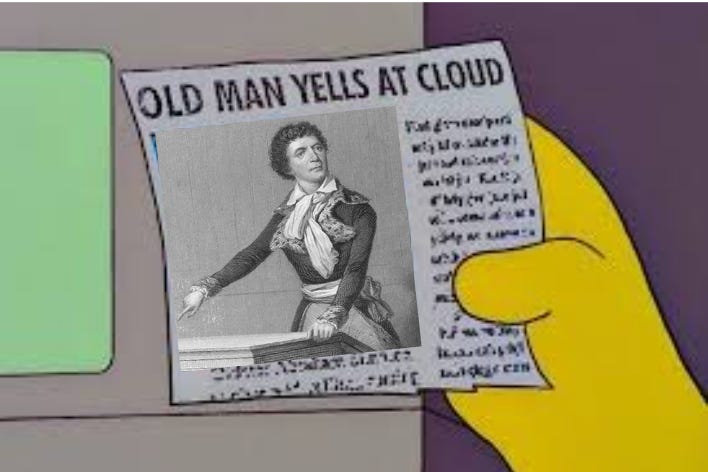
Mister Bastille Yo Girl
Soon, things got spicier at the Estates-General. The Third Estate, or Team Everybody Else, won over a few rogue priests and locked themselves in a tennis court, swearing they wouldn’t leave until they’d written a new constitution for France.
This was in late June 1789. A few weeks later, it was time to STORM THE BASTILLE!!!

Being that there were only seven people imprisoned in the Bastille, this was mostly a symbolic gesture against royal tyranny, and also a great place for fired-up citizens to get a lot of guns very quickly.
Marat says he was present at the storming of the Bastille.*** He claims to have confronted an entire battalion of German mercenaries and spoke so convincingly about the need for revolution that they all laid down their arms and joined the crowd of revolutionaries.*** I assume everyone clapped and then he also wrote a LinkedIn post about it.
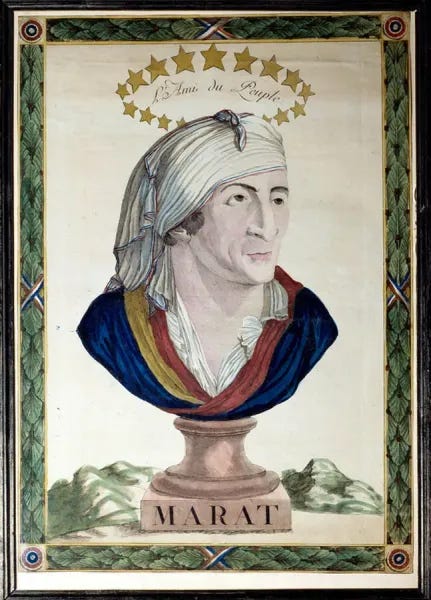
After the fall of the Bastille, Marat ramped up his yelling. He formed the newspaper L’Ami du Peuple, the entire point of which was to say repeatedly “thus-and-such politician is a counter-revolutionary, and no one is being as revolutionary as I, Jean-Paul Marat, would like them to be.” Unsurprisingly, this made Marat a lot of enemies. Between 1789 and 1792, he was repeatedly going into hiding or fleeing Paris for his own safety because he’d made a wild unsubstantiated accusation against someone who hated him.
Where did he hide, you ask? Well. London, sometimes. The provinces, other times. And at least once, IN THE SEWERS OF PARIS LIKE JEAN GODDAMN FUCKIN VALJEAN. [author goes wild, cheering clapping playing “Javert’s Suicide (How Can I Now Allow This Man)” at top volume]
Guys, I swear, Marat is so gross and so weird and he was so ready to leap to the most possible extreme at a moment’s notice. I imagine the scene unfolding like this:
Marat’s wife, Simmone: Honey, hold on just a minute—
Marat, eyes wide, very excited: NO TIME!
Simmone: Like, thirty seconds, we could spend the summer in Geneva—
Marat: IT’S SEWER O’CLOCK, BABE!
[Marat leaps through the window and into an open manhole. Loud squelching is heard receding into the distance.]
Simmone, wearily: OK babe, see you later I guess.
Marat made enemies left and right, but he also made some friends! He was a founding member of the Cordeliers club, a group of shouty radicals from Paris who met up in people’s houses to yell and fanboy over Rousseau and daydream about hanging aristocrats. Other members included Georges Danton, Camille Desmoulins, and Jacques-René Hébert. If these four were alive today they would host the world’s most insufferable podcast.
Smells like Guillotine Spirit
In mid-1792, Marat emerged from a pile of garbage under Paris like some sort of murderous Oscar the Grouch to discover that a fastidious little fucker named Maximilien Robespierre was now leading the National Convention and so was virtually in charge of the revolution. Robespierre hated Marat, as did a lot of other revolutionaries, but I think the relationship between Robespierre and Marat is extra funny because Robespierre was a notorious germaphobe and Marat is, remember, currently dripping in sewage.
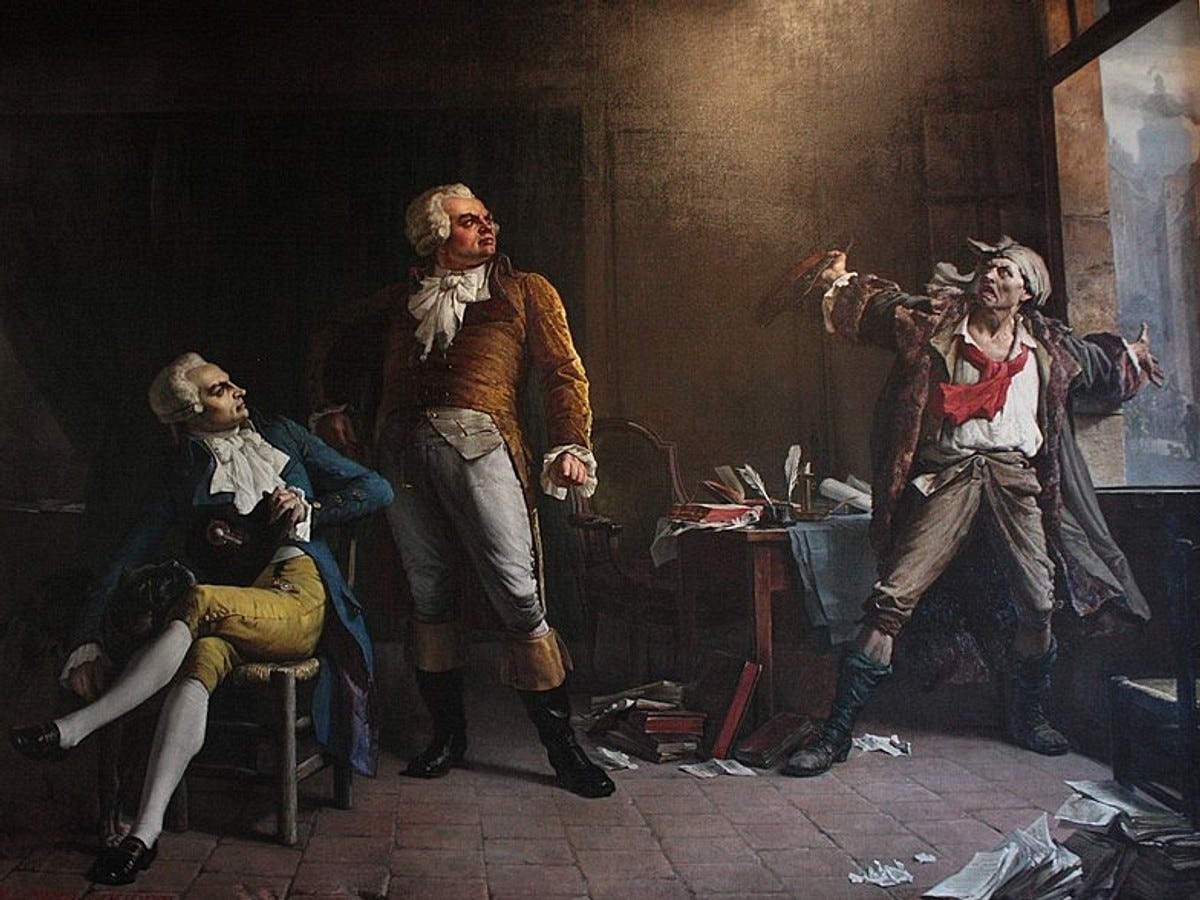
Marat’s buddy Danton is elected Minister of Justice in the Convention at this time. If you were here for my essay on Danton, you remember how profoundly bad of an idea this was. In September, Danton used his position to execute hundreds of prisoners across Paris on the suspicion of being counter-revolutionaries, a category that included “anybody Danton saw at the time.” This was known as the September Massacres, a name that really does not pull any punches.
What was Marat doing during all of this, you ask? Oh, you know. Yelling.
Specifically, writing angry articles about how Danton didn’t murder enough people and how every city in the provinces of France should also have a National Let’s Murder All Our Prisoners Day in the name of the revolution. One thing about Jean-Paul Marat is that he’s always going to be out there just saying stuff.
Late 1792 comes along, and King Louis XVI is arrested and put on trial. He’s sentenced to death and executed by guillotine in January 1793. You probably knew that part was coming. You also probably could’ve guessed that in the aftermath of the death of the king, Marat was—say it with me—out there just saying stuff.
In spring 1793, Marat was publishing pamphlets calling for the National Convention to be replaced by a military tribunal that would have free reign to murder whoever it wanted in the name of the revolution. Some of the more-moderate members of the National Convention responded essentially as follows:

Which, for Marat, was as good as saying “I am a counter-revolutionary and I hope you murder me.” With help from Robespierre, Danton, and Desmoulins, Marat expelled two dozen moderate deputies from the Convention, resulting in a purely extremist government. All of the moderates were guillotined, because these people were not going to invent a stylish mode of execution and then not use it.
Charlotte Corday and the Marats of NIMH
Now. You can imagine that executing virtually an entire political party is going to make you even more enemies, particularly among members of that political party. Which brings us to July 13, 1793, when a new bombshell enters the villa: Charlotte Corday, a 24-year-old political moderate from the countryside. Charlotte arrived in Paris with a two-part plan:
Kill Jean-Paul Marat for political reasons
Look absolutely stunning while doing it
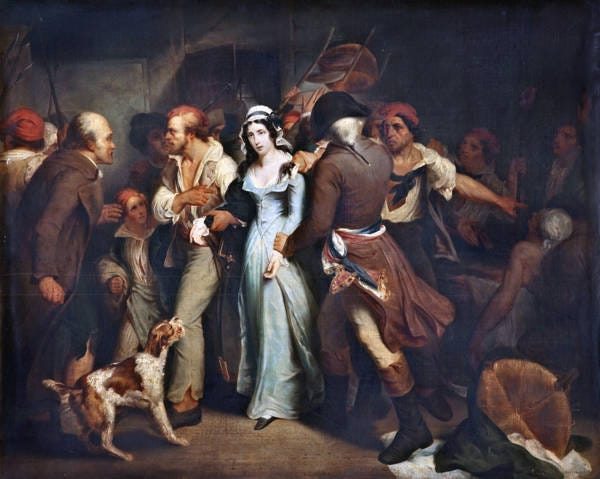
So Charlotte stops off to buy a fetching hat, gets her hair done, writes a note to her dad that says “sorry I’m about to sacrifice myself for the republic,” and heads over to Marat’s house. Where Marat is currently working on revolutionary documents from inside a bathtub shaped like a shoe.
Part of this I can explain: Marat had a debilitating skin condition that got particularly bad when it was hot out, so he was having a bad flare-up. The only way he could get relief was to hang out in a cool bathtub wearing a turban soaked in vinegar. So for the past week or so, Marat had been having a WFT day (Work From Tub) and had set up one of those Gwyneth Paltrow-style bathtub desks to get revolution business done.
The part I can’t explain is why the bathtub is shaped like an old-timey shoe. If any of you know why, please do let me know. I assume the answer is partly, though not entirely, “whimsy.”
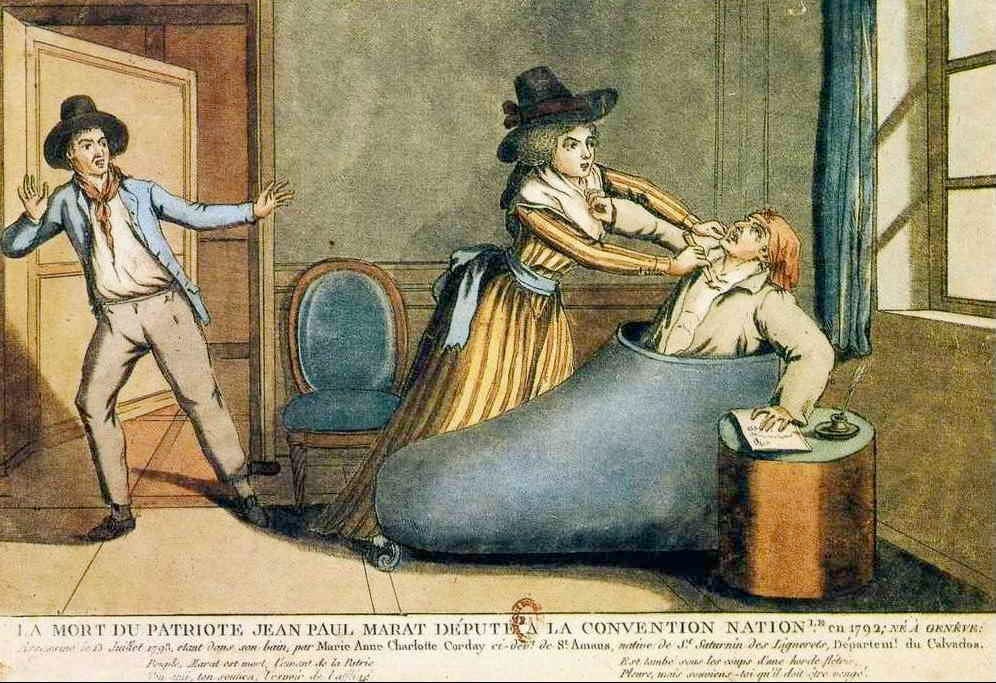
Corday gets Marat’s housekeeper to let her in by claiming she has a list of counter-revolutionary traitors for Marat to murder—as we know, his favorite thing. So she’s admitted into Bathroom Office, at which point she lunges forward and stabs Marat in the chest.
He dies, and that’s the end of the story of Marat.
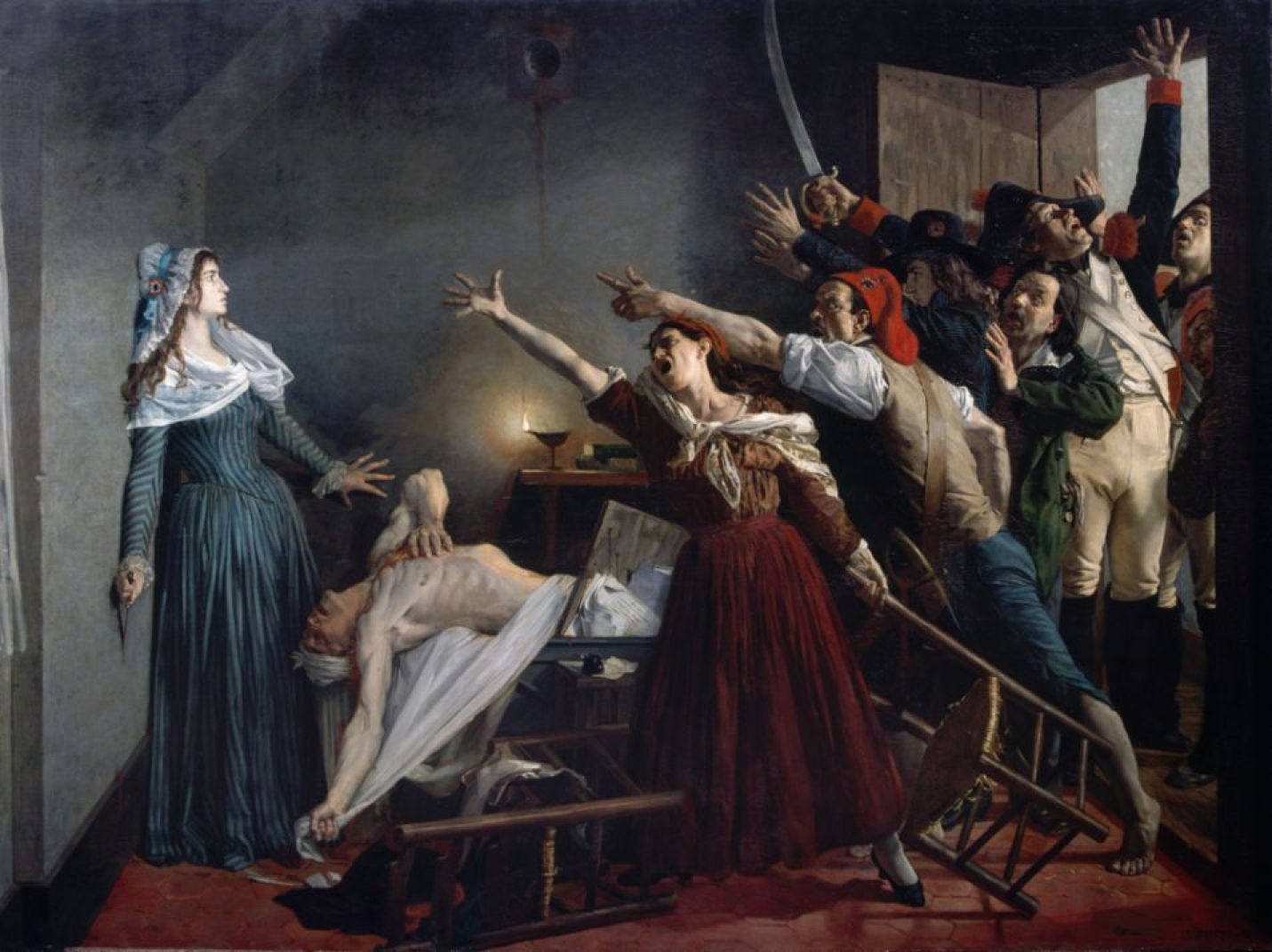
Except it’s not, really. Most people had hated Marat while he was alive, considering him (not wrongly) a stinky old weirdo who had no filter and never met a stranger he didn’t want to guillotine. But as soon as Marat had died for the revolution, he immediately became a hero and a martyr. A flurry of paintings and artwork making Marat out to be the Christ of the French Revolution flooded the scene, including this famous one:
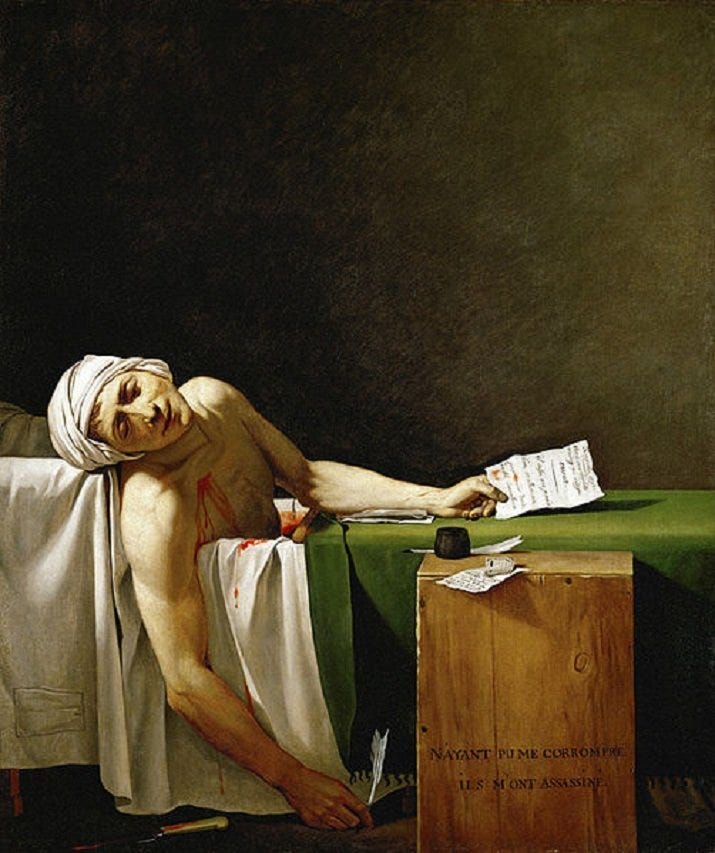
Or this one, in which the people of Paris have all arranged themselves as if they’re extras in the chorus-heavy opening number of a musical:
Or this one:
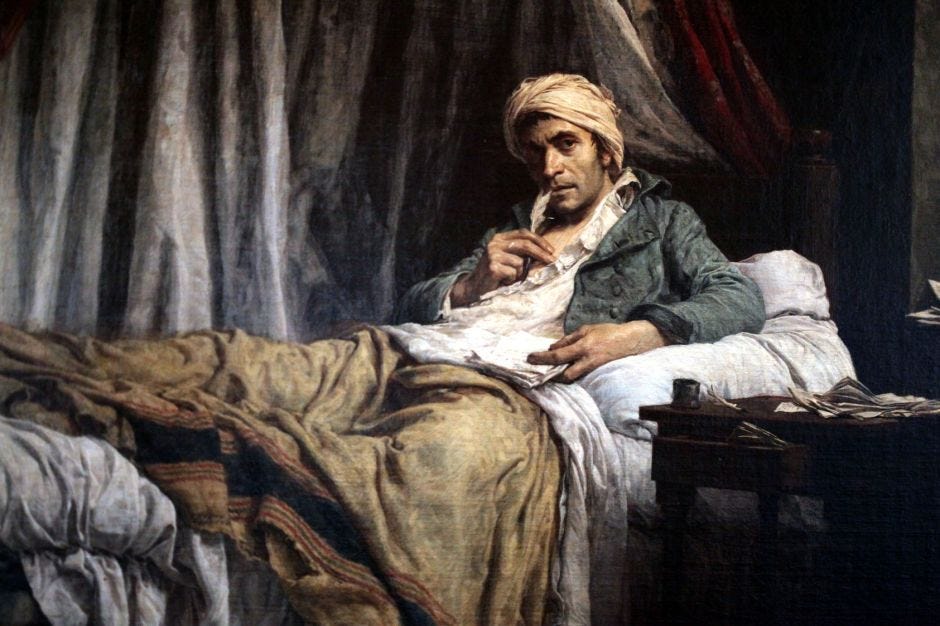
GUYS.
THIS IS THE ONE I’VE BEEN RAMPING UP TO IN THE CAPTIONS THIS WHOLE TIME.
ARE YOU KIDDING ME.
WHY DID THEY MAKE MARAT SO SEXY.
WHY DOES HE LOOK LIKE RUFUS SEWELL.
LUCIEN-ÉTIENNE MELINGUE WHAT HAVE YOU DONE, THIS IS NOT GARBAGE GRANDPA OF THE REVOLUTION JEAN-PAUL MARAT.
Deep breath. Anyway.
The National Convention used the assassination of Marat as an excuse to ramp up murdering “counter-revolutionaries,” which led straight into that cheerful period of the French Revolution known as the Terror. Sort of exactly the opposite of what Charlotte Corday was going for, but I guess sometimes that’s the way the shoe-shaped bathtub crumbles.
All right, friends, that’s all for this time! Thank you as always for joining me on a deeply unserious trip into history.
Until next time, be well, and if you’re able to find a shoe-shaped bathtub that will fit in my one-bedroom apartment please drop the links below and don’t tell my landlord,
-Allison
Unfortunately, I’m realizing that’s what the paid tier of this newsletter is for. Marat would have absolutely thrived on Substack and I hate that for all of us.
Wait... is that... is that AL PACINO relaxing in his bed, waiting for a certain horse's head to transpire in The Godfather, Part 1793?
Incredible. Thank you especially for "Smells like Guillotine Spirit" which has delighted me to an unseemly level.